
I sometimes have exclusive clients visiting me in Tokyo, and once we are done with our agenda they often ask if they shouldn’t have a rope bondage experience while already in Japan. Sure, why not. But then the inquiries begin. What teacher, what style, what school. It’s often presented as something very Japanese. The striving to become a deshi, a disciple or apprentice. That once you have picked, you are kind of locked into this or that way. If you are a student of this master then you can’t be a student of that master. And everyone should know the different masters, to make an educated choice about which one is the best for you. So the exclusive clients ask me, what master is the best for me? I honestly don’t know. But there is something very European about that question in itself. The pursuit of knowledge. Preferably knowledge that has been studied, researched and proven. Many experiments repeated independently of each other and then peer reviewed, and preferably published in the right journals.
I stopped studying rope bondage in Japan a long time ago. But I still go to Tokyo, almost three months every year, and instead I study tea ceremony. I belong to a group — and yes, I actually think belong is the right word, because we are only five students. We meet our teacher every Thursday, for six hours. During that time each student gets the chance to perform the ceremony once, which takes about an hour. When it’s not my hour to conduct the ceremony, I either act as a guest in another’s, or sit silently observing. Kneeling in seiza. A small sadomasochistic session in and of itself. The newest student has been there for two years, every Thursday, six hours, and the oldest for twenty years. I’m a bit of an oddball, joining every Thursday for three months and then disappearing, to live a life I could never tell my class about. Yet they allow me to belong. It feels that way.
The didactics of six hours, five ceremonies, watching four, conducting one — it’s a strange one. It means I get one chance a week to fold the silk and clean the utensils. One chance to pour the water from the cold water container into the cauldron. One chance to make the seven whisks that mix the matcha powder and the boiling water. But I get a lot of time to belong with the group. And I think it ingrains something into me. A way of being.
When I think about it from a rope bondage workshop perspective, it’s kind of ballsy. Imagine someone suggesting the didactics of my tea teacher. Five repetitions of the same tie, do one and watch four. One chance for each knot and rope passage. If you fail, you get to try again next week. Exactly the same tie again. I dare say no one would participate in that workshop. Or leave happy if they did. Still, I feel so committed to my tea teacher. It would feel very strange to leave her next time I visit Japan, to find a new group and try to belong there instead. No, in the rope bondage class there is a different, more European didactics. Divide and conquer. Practise the starting knot a thousand times, get it explained in great detail, try other ways to see why they are worse, have a sharing round with the group, watch a video online, and then move on. To the next knot, to the next tie, to the next workshop occasion, to the next teacher.
Every time I leave Japan, I have to excuse myself for not being able to practise properly — the six-hour Thursdays — for the coming nine months. I try to explain it by not having access to a traditional tea room while travelling, or to all the proper utensils. So my teacher makes an exception for me. She shows me how to make tea in private, on a small round lacquered tray. As you would serve a beloved one in the bedroom. Or carrying everything on the tray into a private study, to disturb your master with a bowl of tea. All the gestures are basically the same, but less loud, more intimate. She explains that this particular tray belonged to her teacher’s teacher. That it survived the firebombings of Tokyo simply by luck. And now she wants me to have it. So I can practise during the nine months until we meet again. I ask her if it comes with a rubber band. She wonders what I mean by that. That in my family, if we are given something precious that we can no longer use properly, we return it to the giver, as if a rubber band were attached. She says no. This is now my responsibility. Exactly what she means by that is somewhat unclear. But how in the world could I ever find another tea teacher in Tokyo?
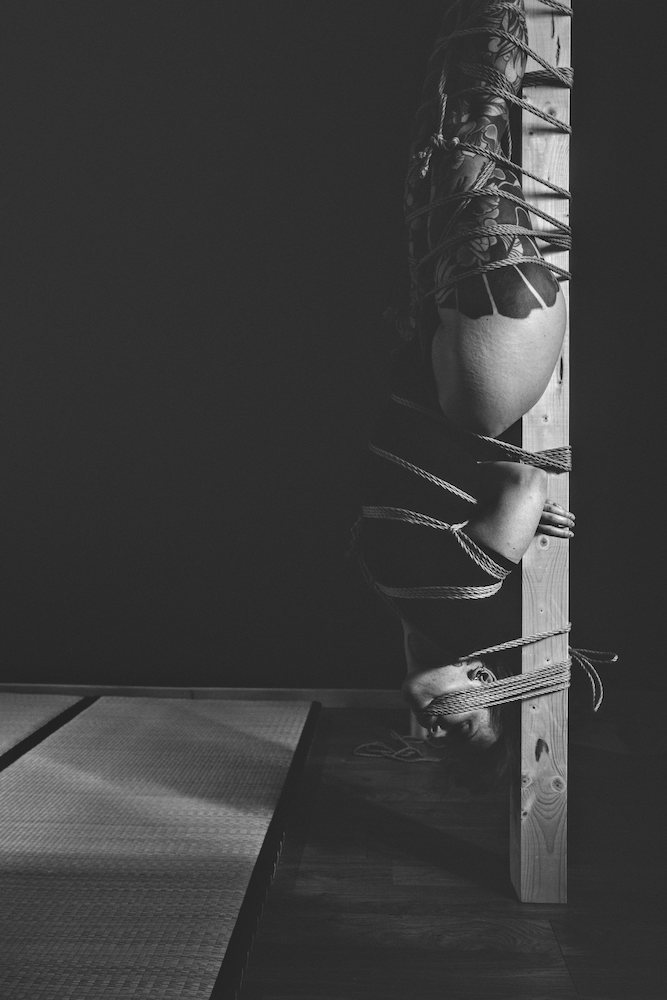
About halfway through my Europe months, I attended my yearly technical rope bondage workshop, to evaluate what of my skills remained, so to speak. It was the hashira workshop by Wildties. Technically amazing. Visually stunning. But then I think about who this is made for. The kind of rope bottom able to endure and enjoy these ties is limited. Because they are rough. There is a joke that half the bottoms usually pass out on the hashira during the first exercise. My partner was one of them, but it was undramatic, and I had been given a very clear exit strategy by the teacher in case it happened. My partner more or less opened their eyes again on the ground, asking how we ended up here and saying that this was the smoothest coming down in a long time. But yes, you need a certain kind of bottom for these ties. And a certain kind of rigger, because it’s skill-intensive, very stressful and high-risk. I would never tie these ties while alone at home. Where I have neither a teacher nor fellow students to help me out in case something happens. Yes, of course, the results are stunningly beautiful. But then I ask myself, is this how niche rope bondage has become? When this is what to strive for? My workshop partner and I nailed five out of the six positions. Good job, pat on the back. But what is next. Something even more complicated? And therefore unavailable.
I don’t know how many other tea teachers there are. I simply got introduced to this one by an older Japanese friend. But it doesn’t really matter, because she is mine. She decided to take me on as a student after some formal introductions, and now we belong together. Maybe it’s different with rope bondage, because there are not so many masters, so it is actually possible to make an educated European choice about which one is the best for individual me. It’s a little bit like sushi bars or ramen joints in Tokyo. There is no best one, there are too many, and they change too rapidly. One closes, another opens, and a third changes owner. Of course, I can argue with my friends over a beer that my favourite is better than theirs. But we will never really know.
About once a month there is a tea party in an old mansion, or a temple, in Tokyo. Where different teachers serve tea in different rooms. And as a participant you can visit many ceremonies in one day. Maybe to pick up on the differences from the style that you study. Or simply to marvel at the dedication. Because I think that is what it’s all about. Dedicating yourself to something meaningful. Something that will remain. Something to depend on. It’s not really about excitement and horniness. It’s not an exploration of perverted desires, which is what I think rope bondage is at its best. Desire is fleeting by nature. And therefore perfect for a short visit to Japan.
So, back to the beginning, when my exclusive clients ask where to try rope bondage in Tokyo, I often say you’re better off going to someone European, an expat in Tokyo, or a Japanese master who has adopted the European didactics. Who will take you for a one-off. Teach you a certain knot, pattern or technique. Or maybe, more realistically, go there as a happy-go-lucky tourist. Have your experience, pay for it, maybe even get a diploma. Because the other way, the more “traditional” Japanese way, is treacherous: once you receive that two-generation-old lacquered tray, you are kind of stuck for life.