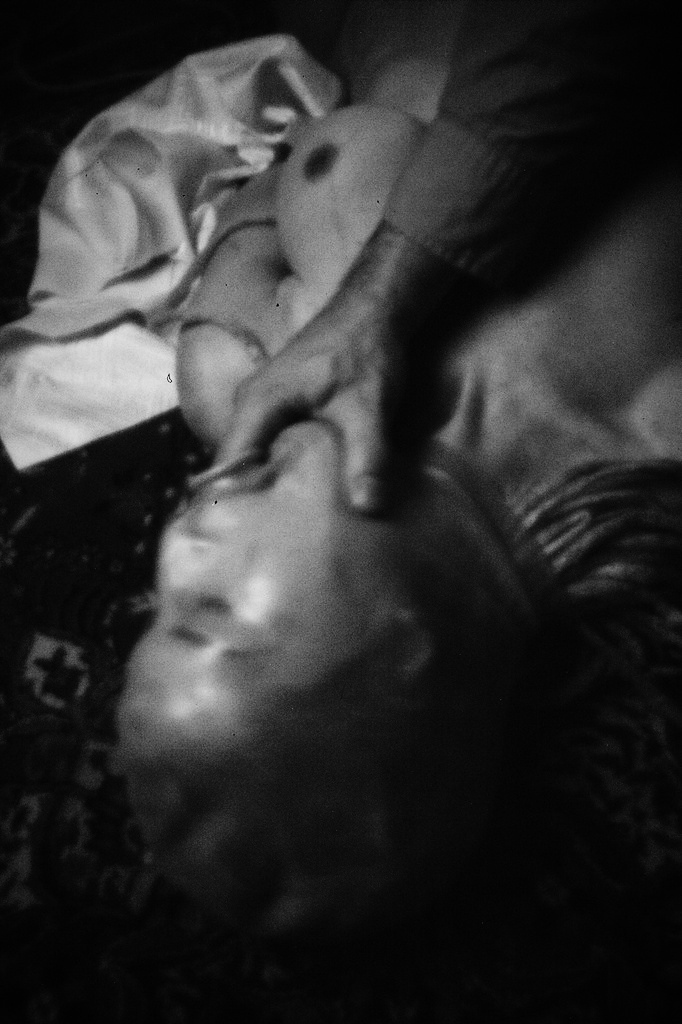
I have to admit that drooling, hypersalivation, and ptyalism (a condition of creating too much saliva) fascinate me. It is probably my second biggest kink after rope bondage, and let me try to digest why. Drooling is ultimately losing control of real bodily functions, appearance, and symbolic social status. Animals, just like Pavlov’s dogs, drool before feeding, and so do infants before they learn to control themselves and adhere to our social norms of cleanliness. Residues leaving the body don’t belong in the public realm. Urine, faecal matter, and menstrual blood belong in the lavatories, while barfing, farting, sneezing, and crying are expected to be discreet. Salivation is on the borderline in between. Losing control is a degradation into something more animalistic that takes us one step further away from the order and cleanliness of civilizations and gods. In a sadomasochistic play, salivation can signify both surrendering to the present moment and submission to a dominant’s desire—allowing oneself to lose part of their humanity.

Drooling and spitting are very different. Spitting is an aggressive and active decision. Culturally it’s seen as an act of rebellion and an attempt to dominate. The sympathetic nervous system rules when stressed or unsafe, so the mouth goes dry, and muscular contraction is needed to force salvation. On the opposite end of the spectrum, drooling belongs to the parasympathetic nervous system, which activates when we are relaxed and ready to receive pleasure through feeding or sexual interaction. Drooling is all about letting go and surrendering to the situation. It reflects an inhibition of action by not swallowing or restricting the saliva. It is being, not doing and having our desires explicitly shown, just like Palov’s dogs. Being an adult is all about controlling our appetite for pleasure so we can focus on being productive instead. When provoked, we can spit at something, actually or metaphorically. But when we let go, we drool.

One can be forced to drool by restricting the ability to swallow. Ball gags, tongue clamps, and dentist spreaders are popular toys in a sadomasochistic collection. But drooling can also come from submission by being instructed to keep the mouth open and not swallow. It may be more challenging than it sounds when eventually, the jaw muscles start to ache as saliva accumulates under the tongue.Every primal instinct urges us to swallow when submitting to being witnessed as a drooling animal. This transformation is ritualistic, as drooling starts slowly, almost unnoticeably. At first, the mouth becomes moist as salivation lubricates the lips and tongue. And soon, the first forbidden drop hangs agonisingly on the lower lip; where and when will it drip out? 

Presenting Our Face

The face is the crown of our humanity; it expresses our emotions and allows our speech to be heard. It forms our relationship with the surrounding world. When the face ‘loses face’ by beginning to drool, we quickly regress to something less civil, predating language. Losing this control is often connected to feelings of shame and taboo, therefore, to be seen and loved in that can be deeply healing. The constant battle to maintain the walls of propriety is suddenly obsolete. It is not won or lost; it’s simply not relevant anymore.

The source, our salivary glands, belong to the body’s lubrication system. It is symbolic of preparing to receive, to be penetrated, and to take the outside world inside ourselves. To surrender and let go. Therefore salivation can be both erotic and therefore also forbidden. It fascinates me that the salivary gland’s activation could be seen as the first tiny step towards making love. ‘Having an appetite for someone’ and ‘drooling all over them’. 

The polyvagal theory, which has received wide attention in only the last decade, speaks about a large branch of nerves which connect most of our viscera to our brains, providing information and feedback in both directions. It helps to coordinate our internal organs with action appropriate to the situations we find ourselves in. This system of communication also has a large emotional component. We have all experienced a huge release from passionate sobbing, where all sorts of bodily fluids come rushing out: tears, saliva, snot, sweat. 

Emotions experienced during sadomasochistic play can also activate such strong releases. Specifically in rope bondage, an emotional release can be triggered by applying physical tension to the body. The body releases emotions, and the emotions in turn release tension from the body. The flowing liquids can be seen as a symbol of both cleansing (like the spring floods which wash away accumulated sediment) and the mysterious unknown.

It amazes me how a clamp on a tongue can trigger this escalating chain of events. For those willing to risk stepping into something more ancient and primal, willing to lose face in front of their partner, why not try, during a bondage session, using a simple clothespin placed on the tongue. You might be surprised by where you or your partner ends up.

40 

Standard Edition. Paperback. 499 pages.


20 

80Mb 7-day digital download. 499 pages.

It took forever, but my book is finally available—either as a printed paperback or a downloadable PDF. Watch the trailer on the left!

Dear unknown friend, to access the adult-rated material you must create a free account and log in. This is due to social media and their algorithms. Sorry for the inconvenience.

FIRST PARADOX

BEING AND DOING

SECOND PARADOX

SELF-SACRIFICE

AND SELFISHNESS

THIRD PARADOX

SELFISHNESS AND

HOLDING SPACE

FOURTH PARADOX

UNITY AND POLARITY

FIFTH PARADOX

SYMBOLS AND REALITY

FIRST RITUAL

SUBMISSION

SECOND RITUAL

DEVOTION

THIRD RITUAL

REJECTION

FOURTH RITUAL

DESIRE

FIFTH RITUAL

DEATH

“M”

Rituals and paradoxes- the intimacy of belonging in sadomasochism and esoteric eroticism by Andy Buru.

“Take my hand, follow me, be not scared, I got you”

“You do not need another guru, do not follow the man with a beard”- the words echoe in my mind when I start reading “Ritual and paradoxes- the intimacy of belonging in sadomasochism and esoteric eroticism” by Andy Buru, professional Japanese rope bondage practionner/teacher: besides almost being named guru, he indubitably takes a position of authority by publishing himself, and considering the subject matter and that I do in fact have some first hand experience of Andy (double-entendre intended) – should I not be a bit scared and keep distance?

Drawing from his extensive experience as teacher, body worker and personal life, Andy approaches the subject through a set of paradoxes that are defining sadomasochism, or “eroticization of pain and power”. These paradoxes create polarities which sadomasochism explores through careful and compassionate play with the inherent tensions that varies between individuals and the power dynamics of ”dominant/submissive”. The resulting book, a solid block of nearly 500 pages, reaches however far beyond an introduction into bdsm, a guidebook, or a collection of personal reflections.

Instead, the aim is to bring attention on esoteric qualities of sadomasochism, as in the ritualization of sexuality towards enlightenment or union with God/Divine. Sadomasochism, with its inherent polarities, has according to the author a high potentiality to address deeper needs usually associated with spirituality, such as belonging, submission, self-sacrifice, and devotion, which according to the narrative are not promoted in our pleasure-seeking western societies (“joy joy lala land”) that mostly focus on achievement and selfishness, on “doing”. The sadomasochism that Andy presents and cultivates provide thus as a contrast a safe playground to discover or further dive into meaningful and transformational states of being.

So what am I holding in my hands? First of all I cannot hinder to be seduced by the format and structure. After all, the presentation is significant when your topic is rituals, and the writing project in itself is introduced as mystic for the author: a compact volume beautifully segmented all in black and white by the paradoxes that define sadomasochism, visually chaptering the thought in numbered lemmas/verses, accompanying poetic lines followed by a clear, straightforward prose, occasionally punctuated by Andy Buru’s warm humour, at the rhythm of sneak peaks into his very intimate (at times thick and sick) diary. Abstract concepts are both cleverly illustrated and made tangible through illustrations and a selection of tastefully curated photographies taken by the author himself during his sessions, seducing with their raw beauty and display authentic vulnerability.

“Rituals and Paradoxes” is a companion to anyone’s own paths of self-/collective exploration- practical or intellectual. Andy Buru acts as a Virgilius, not taking down seven levels of hell as one might associate sadomasochism to, but truly accompanying the reader on a journey. His written edifice is a temple where the dark meanders of eros find light and love, in which the paradoxes are pillars and a room for rituals are formed/performed, and where the self is absorbed in the community. Pushing the comparison further, one might find that the fragments of experience that Andy Buru shares, at moment heavy and intense as incense, are counterparts of the vibrant paintings hanging in the side-choirs of a baroque church. (The dramatic lives of saints and martyrs, full of suffering and self-sacrifice, are after all early tangents to the world of bdsm).

The Reading of “Rituals and Paradoxes” could be an invitation into a sacred place with many shrines and as such be decisive or it may stay at the level of a mere tour, an exotic sight-seeing of deviancy and perversion, depending on maturity and receptiveness of the reader. One anecdote from the book (or should I qualify it as a votive picture in adoration for the Japanese culture and to which the author is so indebted?) may provide some evidence of the author’s expectations on the reader: a flower arrangement school in Japan, where everyone gets the degree, but you would, by paying proper attention, be aware of if you actually got to the deeper sense or not.

I think that the strength of the book comes from this sensible approach, where the mystery, despite being unfold for us and made available in words, by the end of the day needs to be “felt” as well, or to paraphrase the first paradox, “to be”. Regardless of your previous experience in bdsm or more generally within sex, or your degree of self-knowledge, the book has nonetheless something essential to offer as an invitation to discover or further explore the vast inner universe that is yourself and your sexuality, but also, by making you sensible to the esoteric dimensions involved in bdsm and thus to elevate your practice to a profoundly metaphysical act.

Yes, Andy, maybe I will take your hand, and follow you, I am not scared, you got me.