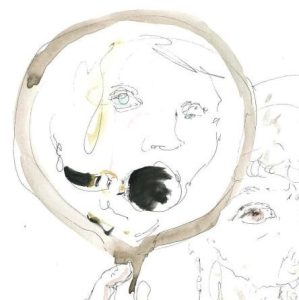
I often describe the symbolic atmosphere of my sadomasochistic play as a sad love story where we witness a hidden desire being slowly revealed. Rawness and vulnerability unfold. The soundtrack of my sessions is in minor scales. Choosing appropriate music is a way to deepen the sessions and reflect the half-hidden pathos underlying the scene.
I remember when I first started teaching in front of a hundred people and how, despite not being fully grounded, as soon as I heard the first familiar notes of music I had chosen, my body dropped into the space, my hand sank deep into my partner’s skin, and my heart was torn wide open. I have never forgotten the power music can have in a ritual space.
I have often experimented with vastly different music genres, ranging from traditional Japanese shakuhachi flutes, minimalistic industrial techno, even humorous tracks by the likes of The Mars Volta or Sonic Youth. However, I always find myself returning to the contemporary composers of my northern roots, like Olafur Arnalds, Arvo Pärt. Perhaps it is because they embody the Scandinavian melancholy that I experience during my sadomasochistic sessions. This same appreciation of decay and imperfection – mirroring the polarity of living and dying – is also embodied in the aesthetic of Japanese wabi-sabi which has informed so much of the way I interface with the outside world. Hanging in a challenging rope suspension is time-limited as the endurance, strength, and slow breath fades away. Surrendering to the situation is a powerful expression of life in metaphorical death.
How to evoke the beauty of this ultimate surrender through music? Olafur Arnalds’ interpretation of Chopin, particularly his Nocturne in C Sharp Minor, is one of the best examples of this feeling. Arnalds’ Reminiscence lingers with the violin’s last dying breaths before the piano lifts everything and carries it away to the place where my play begins.
I am often mesmerised by a master musician’s ability to merge their performance so seamlessly with their self expression. When I can share a jam with such a musician – them with their instrument, me with my ropes – my tying feels like it reaches realms it would not have without this interplay.
I don’t believe there always needs to be an entire soundtrack for a sadomasochistic play. A single song can set the tone, like an overture, and the echoes reverberate throughout the session and well beyond. I remember a tying performance in a loud Berlin nightclub. At first everyone was dancing to the electronic thuds while the performance emerged in the middle. The volume of the music was gradually turned down over several minutes as the tying got more intense. People’s attention became more focused on the action and less on the dancing until eventually everything stopped. All that could be heard in the room full of people was the sound of two people breathing and moaning. This was far more dramatic than any music could be just then. The music had disappeared but its impact lingered powerfully.
Silence can also be the appropriate music for a session. Just like choosing the right artwork and flower arrangement to greet your guest in a tea ceremony, just as the tea master will be sensitive to the significance and reason for the meeting in selecting which tea to serve, so too can an appropriate choice of music – or lack of it – offer the receiver a deeper sense of being seen, held, felt.