
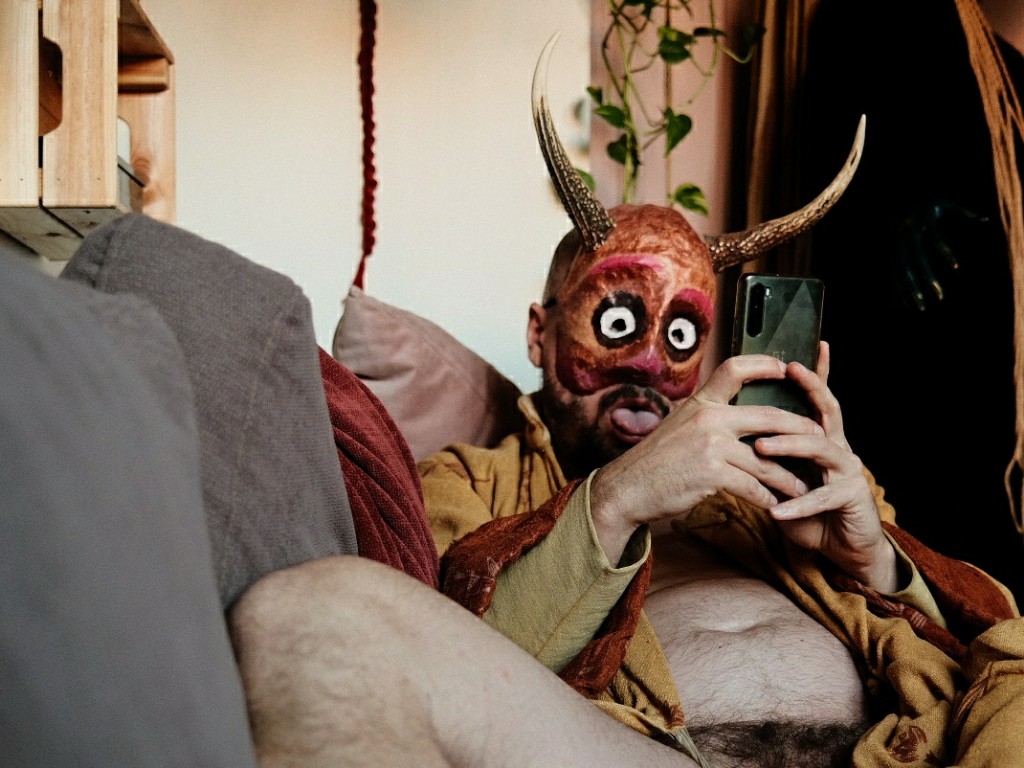
I remember a whipping scene at a fetish show I attended in Tokyo. The person wielding the whip seemed obsessed with their own grandeur, and their technique was without rhythm and finesse. I was half-expecting the receiver to stand up, excuse themself and exit the stage bowing. Despite these flaws, what made the performance so captivating for me was the display of bottled up emotions on the part of the one whipping. His palpable fear of something not ending up as imagined ahead of time. Another scene at the same show. A man enters the stage cradling a log as his newborn baby. He sings a lullaby, as a mistress enters the stage. While he entertains the audience, she paints a smiling mouth and wide open eyes on his face. There is also a bar stool with a hammer and a handful of nails. The singing man places his log on the bar stool and his genitals on top. The tune changes to ‘Non, je ne regrette rien’. I have no regrets in French. And he sings loudly while the mistress nails his ball sack to the log. Again, there was a real sacrifice.
Often my thoughts circle around performing. Over and over again. So many people I talk to are scared of performing. They are plagued by thoughts that they are not good enough or that their kink may not be kinky enough. When studying theatre, I spent a lot of time considering what constitutes a performance. Is it simply a forum through which a story is told or is it something which showcases a difficult skill, or is a performance merely something eye-catching or a bold political statement?
To me, a core aspect of any performance is when the viewer becomes captivated by a perceived inner conflict going on in a performer. One of Stanislawski’s theatre exercises demonstrates this. In it, one person sits silently on stage, tasked with solving a philosophical problem in their head. The audience has no idea what the person is thinking, but the mere act of watching someone engage with a challenging task in real time can be deeply engaging.
In my opinion, sadomasochism offers something unique to perform: real emotions. I recall a comment made by choreographer Felix Ruckert, who suggested that wielding a whip can instantly generate the same level of presence that a professional dancer might spend years cultivating. However, I believe that in order for a performance to be art, there must be something at stake–some element of uncertainty or insecurity that adds tension to the experience.
Ultimately, I believe that there is an unspoken agreement between performers and their audience, one that revolves around the idea of offering up an experience–however raw or vulnerable–and inviting others to witness it. Whether that experience takes the form of a traditional theatrical performance at my directing school or a sadomasochistic scene in Tokyo, what matters is the sense of emotional intensity and presence that it creates.
Celebrating The Taboo, The Broken and Incomplete
One big reason for performing is to celebrate a subculture by giving it space and attention. Sadomasochism, as one example, is all about diversity, and there is the idea that – your kink is not my kink, but your kink is okay. Performing is opening a window into a bedroom, dungeon or ritual space typically closed. In this way, it inspires others. Sometimes I hear people say they don’t need to perform to validate themselves, that they are fine as they are. Of course, this is true. But there can also be a lot of unacknowledged fear hiding behind that statement.
There was once a great discussion in this hippie community in the Swedish woods about the open stage and who should be encouraged to perform there. Some argued that it was for the most insecure, maybe with the most minor talent because they are the ones most in need of space and that as long as they are offered the audience’s presence and emotions, then it will be a beautiful experience. I genuinely believe this to be true.
Another way to approach this question is to consider the ongoing discussion within sadomasochistic circles about what constitutes ‘good’ and ‘bad’ experiences. In my view, performing is a powerful way of bringing these debates to life and creating a space for emotional participation rather than just verbal or written discourse. Performances allow the audience to engage with the experience on a deeper level, tapping into their emotions rather than just their imaginations. This is particularly important in an era where so much of our lives are lived online, and people are often more concerned with projecting a certain image or living out a pre-imagined fantasy than with engaging in real, raw, spontaneous, messy experiences.
I aim to create a space where individuals can be seen and heard, and where celebration and meditation coexist. This space is different from typical living room sadomasochism clubs, which often offer a laid-back atmosphere with comfortable sofas and beer. While these clubs are nice, my vision is to create something opposite, a space where individuals can dress up, take a leap of faith, and aim for something magical, or they can meditate, slow down, and embrace their insecurities. Or even better to do all of this at the same time. Call it a sadomasochistic church or an institute of embodied philosophies.
In this performative sexual space, dedication is necessary, and in return, it offers arousal rather than relaxation. One critical element is that everyone is both an audience and a performer, eliminating the hierarchical structure of who is better than whom. While those with more experience and reputation may receive more attention, the open structure allows anyone to challenge that and contribute to the culture. This is my proposal for a new kind of space that merges celebration and meditation, performance and audience, and allows individuals to define what the club is all about.


