I remember the closing ceremony of an esoteric festival as an echo of an emotional rollercoaster. We sang and danced, and we got high on the simple fact of being alive. It was a celebration. A structured doing and a place where I could find and lose myself at the same time. There was a bubbling quality that felt like the feast itself was simmering in a delicious pot – hundreds of small meetings simultaneously happening and merging, creating its own special soup. It weaves a social web of interactions, and something is born, a human-machine working for one purpose. We are here to explore Scandinavian esoterism, but it could be anything; the structure is not dependent on the subject. 

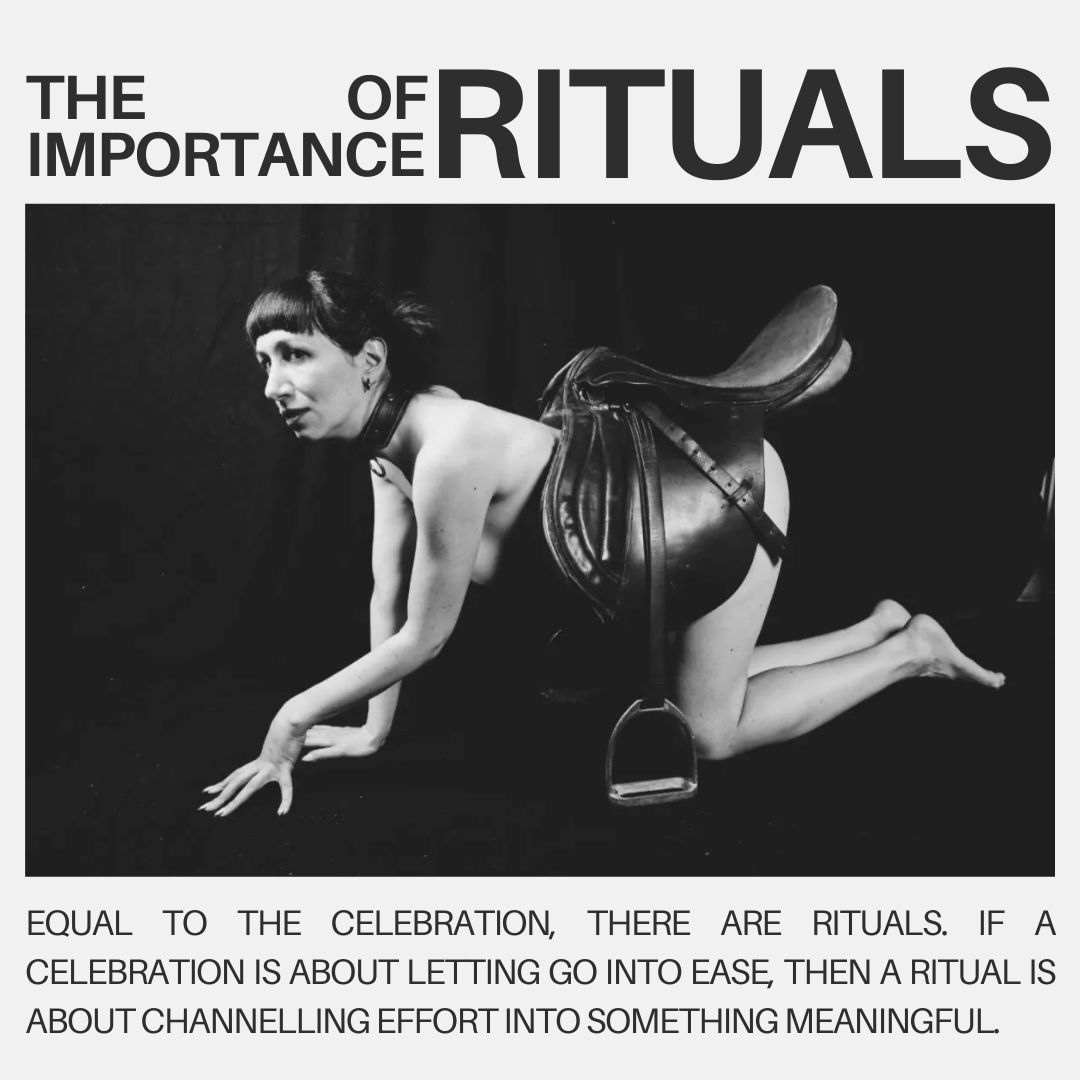
Equal to the celebration, there are rituals. If a celebration is about letting go into ease, then a ritual is about channelling effort into something meaningful. It’s like cultivating a relationship with another self. Participating in these ritualistic spaces is easy to learn but takes a lifetime to master. Both benefit from the participation of a lot of people, and that’s why they fit so well into festivals – gathering places where people come together to share a common purpose. 

To contribute in a ritual, the participants need to know their role and how their actions can express that. The first step is attention. This can manifest as inward silence, amplifying a specific person or event, or creating a shared group experience. It always starts with awareness through the senses – seeing, feeling, hearing – as well as through the breath. Consciously witnessing something brings relevance and importance to it. If I get whipped alone in the woods, it’s only the two of us, but when there are witnesses, it becomes something much greater.

By consciously deciding to pay attention to something, one either empowers or condemns it. This dynamic can be seen everywhere: in concerts, sports arenas, and religious centres. I believe this is so deeply ingrained into our behaviour as social beings. It is closely related to exhibitionism and voyeurism.

The next step in participating in a ritual is allowing yourself to react – first by witnessing, then by opening up emotionally, and finally by allowing yourself to respond without prediction or preparation. Finally, when reactions are bubbling together in the same pot, they may form interactions. A Japanese tea master once told me that chado (tea ceremony in Japanese) is essentially a series of unrepeatable actions and responses which always depend on the particular combination of people and elements. It’s the same concept as ichigo ichi-e – that one can never step into the same river twice. I believe this is the key to participatory culture as opposed to a consummative one.

The Participatory Nature In Reality

Let me illustrate the participatory nature of ritual with a little story from one of my favourite submission rituals. We are all gathered in a circle, about two hundred fifty of us. We are sitting in silence and our attention is directed towards the centre. One lone woman steps into the empty space inside the circle, claiming it entirely; she is at once graceful and powerful. Her eyes are on the hunt. A man stands up and walks in front of her. Their eyes meet. He is looking for her to yield to him. A wordless thunderstorm rages in the room. Yet she does not give in, and eventually, he returns to his place in the circle – beaten. Another man rises and enters the circle. The result is the same. The men stand held by her gaze, seen by everyone, only to abandon their effort and walk away. She is the queen of motherfucking everything.

Something shifts. The next man to approach drops to his knees in submission in front of her, awaiting her embrace. She looks down at him. The entire room looks at them both. She turns and walks away. She is unclaimable. Neither submission nor dominance seems to have any effect. There is a deep stillness in the room as she paces alone in the eye of the storm. Eventually, another woman stands up, catches the queen’s gaze, and drops to her knees. This time, the queen embraces her and dominates her in front of everyone. She grabs her by the hair and leads her around the room on all fours. 

At first, her crawl is nervous, so the queen teaches her grace. To be a proud, owned slave. While the circle is watching, the queen sits down on her lower back and pulls the neck back, kissing, licking and biting the throat’s softly exposed skin. Then, unexpectedly, the queen commands her slave to mount her, claiming her queen, just the way all these men around them dream of doing. Slowly, more and more people join the centre, reacting viscerally to her display of power. Men start to surrender to women. This is beautiful in its authenticity because it reflects something that we all created together; with our attention, our actions and reactions. And we instinctively know that this would be completely different the next time. Ichigo ichi-e.

The Western Mind Doesn’t Like Rituals

Ritualistic spaces can be challenging for a beginner, especially one with a Western mind. Modern culture is unused to tradition, ritual, ceremony. And yet I can see that people long for this kind of experience. As a facilitator, it is my responsibility to clearly communicate that we are entering into a ritual space. Not everyone may be able to see the invisible connections we are trying to create. The goal of these ceremonies is to move beyond individual egos and create a shared experience for the group. Even a small amount of social chatter, playful flirting, or expressions of joy can disrupt the ritual and emphasise individual pleasure over a shared communal experience. Once this starts to unravel, it can be difficult to regain focus – because no one wants to miss out on a pleasurable party, right?

40 

Standard Edition. Paperback. 499 pages.


20 

80Mb 7-day digital download. 499 pages.

It took forever, but my book is finally available—either as a printed paperback or a downloadable PDF. Watch the trailer on the left!

Dear unknown friend, to access the adult-rated material you must create a free account and log in. This is due to social media and their algorithms. Sorry for the inconvenience.

FIRST PARADOX

BEING AND DOING

SECOND PARADOX

SELF-SACRIFICE

AND SELFISHNESS

THIRD PARADOX

SELFISHNESS AND

HOLDING SPACE

FOURTH PARADOX

UNITY AND POLARITY

FIFTH PARADOX

SYMBOLS AND REALITY

FIRST RITUAL

SUBMISSION

SECOND RITUAL

DEVOTION

THIRD RITUAL

REJECTION

FOURTH RITUAL

DESIRE

FIFTH RITUAL

DEATH

“M”

Rituals and paradoxes- the intimacy of belonging in sadomasochism and esoteric eroticism by Andy Buru.

“Take my hand, follow me, be not scared, I got you”

“You do not need another guru, do not follow the man with a beard”- the words echoe in my mind when I start reading “Ritual and paradoxes- the intimacy of belonging in sadomasochism and esoteric eroticism” by Andy Buru, professional Japanese rope bondage practionner/teacher: besides almost being named guru, he indubitably takes a position of authority by publishing himself, and considering the subject matter and that I do in fact have some first hand experience of Andy (double-entendre intended) – should I not be a bit scared and keep distance?

Drawing from his extensive experience as teacher, body worker and personal life, Andy approaches the subject through a set of paradoxes that are defining sadomasochism, or “eroticization of pain and power”. These paradoxes create polarities which sadomasochism explores through careful and compassionate play with the inherent tensions that varies between individuals and the power dynamics of ”dominant/submissive”. The resulting book, a solid block of nearly 500 pages, reaches however far beyond an introduction into bdsm, a guidebook, or a collection of personal reflections.

Instead, the aim is to bring attention on esoteric qualities of sadomasochism, as in the ritualization of sexuality towards enlightenment or union with God/Divine. Sadomasochism, with its inherent polarities, has according to the author a high potentiality to address deeper needs usually associated with spirituality, such as belonging, submission, self-sacrifice, and devotion, which according to the narrative are not promoted in our pleasure-seeking western societies (“joy joy lala land”) that mostly focus on achievement and selfishness, on “doing”. The sadomasochism that Andy presents and cultivates provide thus as a contrast a safe playground to discover or further dive into meaningful and transformational states of being.

So what am I holding in my hands? First of all I cannot hinder to be seduced by the format and structure. After all, the presentation is significant when your topic is rituals, and the writing project in itself is introduced as mystic for the author: a compact volume beautifully segmented all in black and white by the paradoxes that define sadomasochism, visually chaptering the thought in numbered lemmas/verses, accompanying poetic lines followed by a clear, straightforward prose, occasionally punctuated by Andy Buru’s warm humour, at the rhythm of sneak peaks into his very intimate (at times thick and sick) diary. Abstract concepts are both cleverly illustrated and made tangible through illustrations and a selection of tastefully curated photographies taken by the author himself during his sessions, seducing with their raw beauty and display authentic vulnerability.

“Rituals and Paradoxes” is a companion to anyone’s own paths of self-/collective exploration- practical or intellectual. Andy Buru acts as a Virgilius, not taking down seven levels of hell as one might associate sadomasochism to, but truly accompanying the reader on a journey. His written edifice is a temple where the dark meanders of eros find light and love, in which the paradoxes are pillars and a room for rituals are formed/performed, and where the self is absorbed in the community. Pushing the comparison further, one might find that the fragments of experience that Andy Buru shares, at moment heavy and intense as incense, are counterparts of the vibrant paintings hanging in the side-choirs of a baroque church. (The dramatic lives of saints and martyrs, full of suffering and self-sacrifice, are after all early tangents to the world of bdsm).

The Reading of “Rituals and Paradoxes” could be an invitation into a sacred place with many shrines and as such be decisive or it may stay at the level of a mere tour, an exotic sight-seeing of deviancy and perversion, depending on maturity and receptiveness of the reader. One anecdote from the book (or should I qualify it as a votive picture in adoration for the Japanese culture and to which the author is so indebted?) may provide some evidence of the author’s expectations on the reader: a flower arrangement school in Japan, where everyone gets the degree, but you would, by paying proper attention, be aware of if you actually got to the deeper sense or not.

I think that the strength of the book comes from this sensible approach, where the mystery, despite being unfold for us and made available in words, by the end of the day needs to be “felt” as well, or to paraphrase the first paradox, “to be”. Regardless of your previous experience in bdsm or more generally within sex, or your degree of self-knowledge, the book has nonetheless something essential to offer as an invitation to discover or further explore the vast inner universe that is yourself and your sexuality, but also, by making you sensible to the esoteric dimensions involved in bdsm and thus to elevate your practice to a profoundly metaphysical act.

Yes, Andy, maybe I will take your hand, and follow you, I am not scared, you got me.