
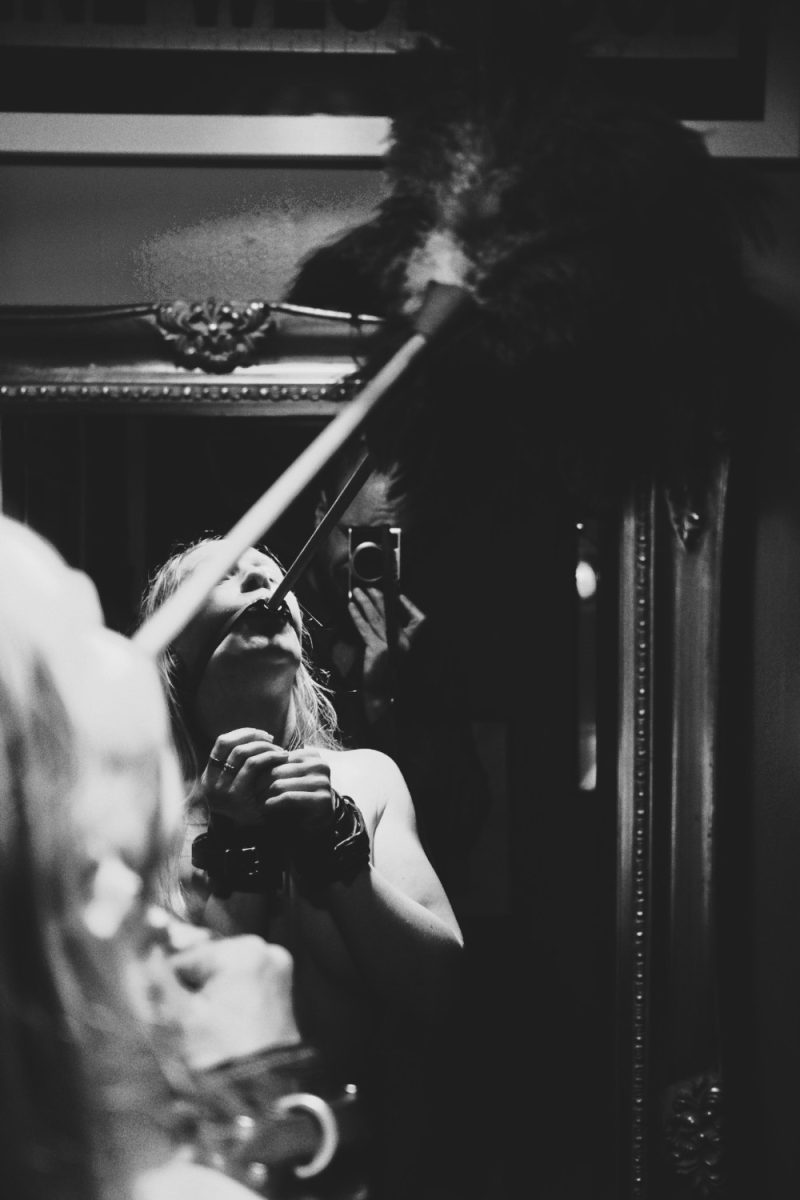
First, it’s necessary to realise that the person entering a ritual is different from the person who woke up this morning; this is a transformative process. This may be so obvious that most no longer notice it. Of all the ways a person can contribute to a ritualistic space is by taking responsibility for themselves, and by preparing as much as possible. This process begins with my own appearance, which communicates my intentions to those around me. This is more to it than just surface-level dressing up. The outfit I choose holds a deeper meaning for me, and it allows me to embody a particular flavour of my persona which aligns with my desires. By putting effort into the preparation and maintenance of this persona, I am able to fully embody it in the ritual.
In order for all this to occur, however, I must allow enough space for it. Living in northern Scandinavia, I love isolation, sauna and fasting. The long winter nights provide a sense of isolation which allows me to focus on my inner world and surroundings, revealing details and feelings that may have gone unnoticed before. It’s a kind of reminiscence that allows me to grasp things that exist at the edge of my awareness. I remember as a kid my fascination for the nocturnal, walking in the woods surrounding Stockholm, and observing the interplay of shadows in interwoven shades of darkness. It brought me an inherited sensation of peace.
Daytime is often consumed with mundane tasks like eating, working, exercising, and socialising, which leave little space for the unknown. However, the night is endless and dream-like, and combining it with fasting and sauna enhances the experience further. By shutting down my digestive system, I become more sensitive and aware of my surroundings, as my body is not occupied with breaking down food. I also break the repetitive routines involved in eating and meal preparation. The habit of visiting an woodfired sauna by the river allows me to cleanse my system and prepare for something new by emptying my pores and lymph system. It’s a symbolic preparation for what’s to come.
Entering Together For The First Time
Newcomers to rituals can feel as if they lack a fantasy or desire. However, I reassure them that just entering this unknown space is enough. I advise them to avoid overdressing in any particular direction and instead symbolise their freshness by being like a clean sheet of paper, ready to be written upon with the ink of those more experienced. Alternatively, if they feel scared or intimidated, they can choose to hide behind a veil, but it can also be important to challenge that fear and be brave in embracing their shyness as opposed to simply pretending to be more comfortable than one really is.
Felix, a mentor of mine, taught me the value of humility when entering a new space. I arrive as a newcomer in an unknown space, I have less knowledge, confidence and connections, and therefore I start at zero. Asking how I can serve or learn about this otherworldly culture can be an elegant and instinctive approach. Pretending to be something I’m not will only create fear and distance, making it impossible to participate in the ritual. So, it’s essential to honour our starting point and approach the experience with authenticity and humility.
The second step of preparation involves relationships with others. Few fantasies and desires are solo activities; if they are solo, one has probably already explored them alone. It’s through interaction with another that polarity can be created. Thus, attending a ritual with a partner can be very helpful, and it is important to prepare that connection. The easiest is to establish a shared language together, a body language with possibly an additional spoken language. Spending a short time together in a non-verbal activity, I believe, like staying in prolonged eye contact, sharing a silent mutual massage, or moving together as in a dance, aids in the creation. Usually, five minutes is enough to establish how to touch each other, be led in a particular direction, say stop, and more. By doing this, when we later meet at the ritual, we will have an invisible bond of intimacy that we know how to play with.
Entering Into A Relationship With Space
The third area of preparation is in my relationship to the space itself, and how to transform it into an arena for the fulfilment of desire. And how to use it to realise the desire. A good ritual is a playground for potential fantasies. Some areas within the space would be well-lit, others covered in shadows or lurking behind curtains, some open spaces, others elevated as stages. Some pieces of diverse functionality furniture will be placed, something symbolic maybe like a Saint Andrew’s Cross and something practical like a large leather couch, maybe a throne, a lone porcelain toilet, etc. There might be hardwood floors on which human dogs can crawl, and a cosy corner with cushions for cuddling. Whatever exists in the space, must allow for interaction. Things can’t just be decor. Everything must be real and allow for play.
Relating to the space also happens on another level by immersing myself in it or giving myself to it. This is because my fantasies become physically manifested, affecting everyone. It’s a tangible environment made up of flesh and bones. I remember a naked woman being led around at a ritual; she wore only black high heels and on her bare chest in black ink was written ‘Camera Obscura’. Her eyes were closed most of the time except for when she was placed kneeling before a partner to observe and record the unfolding acts of desire with a ‘click’. Her gaze had a tremendous impact on attendees at that ritual.
Proper preparation for a ritual is like planting a seed and watching the unexpected ways it grows. This participation in the creation and destruction of something unique and ephemeral begins long before the events begins.
It’s rare to come across truly amazing rituals, so it’s appropriate to view my participation as a sacrifice of myself, my relationships, and the space. It’s also an opportunity to express something within myself. It often happens unconsciously, such as preparing a unique outfit or something more abstract and symbolic. It may even be a deeply buried desire that requires preparation and courage to bring forth and display. But, of course, this might be almost impossible to achieve as a newcomer, so the sacrifice is to give one’s time and attention to another’s desire and prepare to be humble and serve. Viewing a ritual as a form of a sacrifice and preparing for it in this way makes it truly magical. As the saying goes, “you reap what you sow.”


